Bunny with Egg Silhouette Sublimation
First Impressions: A Quiet, Charming Easter Motif
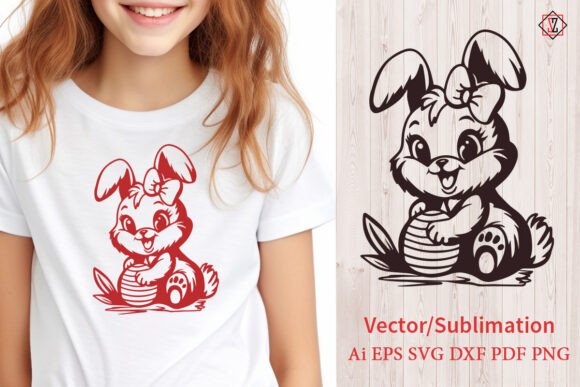
When I opened Bunny with Egg Silhouette Sublimation, I wasn’t met with frantic Easter energy—no glitter bombs, no hyper-detailed florals, no overwrought expressions. Instead, there’s a soft, confident simplicity: a clean-line bunny profile cradling a single egg, balanced and centered. It reads instantly as spring—but not in a kitschy way. It feels like something you’d stitch onto a linen tea towel for a boutique kitchen line, or embroider subtly on the chest of a baby onesie for a client who values quiet craftsmanship over loud trends. As an illustration, it leans into negative space and silhouette strength—exactly what makes vector-based embroidery designs hold up so well across scales.
Where This Design Shines in Real Embroidery Projects
I recently tested Bunny with Egg Silhouette Sublimation on a natural cotton tote bag for a local nursery shop’s spring collection. The result? Calm, cohesive, and unmistakably handmade. Because the outline is smooth and uncluttered, it stitched cleanly at 3.5 inches wide—even on medium-weight canvas with standard tear-away stabilizer. No skipped stitches, no thread breaks, no need to slow down the machine. That’s rare for holiday-themed graphics that often sacrifice clarity for cuteness.
It works especially well for:
- Sweatshirt embroidery—the shape fills nicely on left-chest placement without overwhelming the garment
- Embroidered patch—clean edges mean crisp heat-applied or sewn-on results
- Baby embroidery—no tiny details to snag or unravel; ideal for onesies and burp cloths
- Holiday embroidery—it reads as Easter without needing bunnies *and* eggs *and* baskets *and* chicks
- Printable mockup—its vector roots make it easy to scale for digital previews on Etsy or Instagram
For craft business owners, this isn’t just another Easter clipart file. It’s a design asset that supports brand consistency—whether you’re selling embroidered pillow covers on your small shop site or bundling it as part of a seasonal digital embroidery file pack.
Where to Proceed Thoughtfully
Like any silhouette-based design, Bunny with Egg Silhouette Sublimation depends heavily on contrast and context. On dark fabric, it needs either light thread or a subtle underlay fill to prevent the shape from disappearing into the background. On textured fabrics—like terry cloth towels or loop-back sweatshirts—I recommend adding a light cutaway stabilizer underneath to keep the lines sharp and prevent puckering.
Avoid pushing it too small. Below 2 inches, the egg detail starts to blur in satin stitch, and the curve of the bunny’s ear loses definition. For caps or curved surfaces, test stitch first: the gentle arc of the silhouette adapts well, but avoid placing it directly over seams or high-stretch zones unless you’ve added stretch stabilizer.
Also consider the end use. If this is going into a finished product meant for frequent washing—say, a child’s embroidered apron or kitchen towel—verify that your chosen stitch density balances coverage and flexibility. Too dense, and the fabric stiffens; too sparse, and the shape loses presence.
How It Shapes Perception—Before and After Stitching
Customers notice intentionality. When someone sees Bunny with Egg Silhouette Sublimation on a hand-stitched gift, they don’t just register “Easter.” They sense care—the kind that comes from choosing a design with breathing room, visual weight, and restraint. That translates directly to perceived value. A personalized gift stitched with this motif feels more curated than mass-produced, even if it’s made on a home embroidery machine.
For Etsy sellers and small shop owners, that matters. It builds trust—not just in your stitching skill, but in your eye for design. And because it’s rooted in illustration rather than photorealism, it photographs beautifully in natural light, helping your listings stand out without heavy editing.
Practical Designer Notes Before You Stitch
Here’s what I do before committing Bunny with Egg Silhouette Sublimation to a real project:
- Test on scrap fabric—same weight, same color, same stabilizer as your final piece
- Check thread color contrast—try it in ecru on oatmeal linen, navy on cream, and charcoal on ivory
- Review stitch density—especially around the egg’s curve and bunny’s inner ear where fill and satin stitches meet
- Confirm hoop size compatibility—its proportions suit standard 4×4 and 5×7 hoops comfortably
- Inspect small details—zoom in on the vector file to ensure no stray anchor points or overlapping paths
- Test black-and-white mockups—this design relies on shape, not shading, so grayscale previews reveal how well it’ll translate
- Compare light vs. dark backgrounds—not just for thread choice, but for how the silhouette holds its form
- Use proper stabilizer—medium-weight cutaway for knits, tear-away for stable wovens
- Verify licensing—since it’s categorized as Illustrations and Graphics, confirm whether commercial use (e.g., selling finished embroidered totes) is permitted before listing
A Design That Supports Your Work—Not the Other Way Around
Bunny with Egg Silhouette Sublimation doesn’t demand attention—it earns it. It’s the kind of embroidery file that disappears into your process while elevating your output. Whether you’re stitching custom apparel for a local preschool, building a cohesive line of holiday embroidery for your craft fair booth, or designing printable mockups for a digital product bundle, this motif supports your voice instead of overriding it.
It’s not flashy. It doesn’t try to be everything. But for makers who value clarity, calm charm, and quiet professionalism, it’s exactly the right kind of Easter design—one that looks intentional, stitches reliably, and helps your handmade product feel thoughtfully complete.