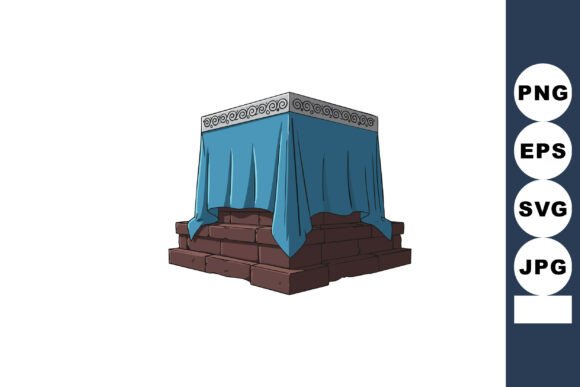
Stone Altar with Blue Cloth Covering
A Quiet, Reverent Shape — Not Just Another Graphic
First glance at Stone Altar with Blue Cloth Covering tells you it’s not loud or flashy — and that’s its strength. As an embroidery designer who’s stitched hundreds of motifs for boutique apparel, nursery decor, and personalized gifts, I immediately sensed its quiet authority. The clean vector lines, the gentle drape of the blue cloth over solid stone, the subtle decorative border — it reads as intentional, grounded, and unhurried. It doesn’t shout “look at me”; it invites pause. That makes it ideal for projects where meaning matters more than momentum: baptismal keepsakes, meditation-themed apparel, spiritual wellness brands, or heirloom baby blankets.
Where This Design Truly Lives in Real Embroidery
I tested Stone Altar with Blue Cloth Covering on a linen-cotton tea towel and a midweight organic cotton tote — two staples in my craft business. On both, it stitched cleanly without excessive density or tiny fragile elements. The shape holds up beautifully at 3.5–4.5 inches wide, which fits neatly inside standard 4” x 4” hoops. No satin stitch traps, no thread nests in corners, no need to re-hoop mid-stitch. It’s not an applique design — it’s a single-layer fill-and-outline machine embroidery design, so it works well for sweatshirt embroidery (with tear-away + cutaway stabilizer) and baby embroidery (when paired with soft, low-density fill stitch settings).
It shines brightest on products where simplicity reads as sincerity: embroidered patches for yoga studios, minimalist pillow covers for mindful living boutiques, or holiday embroidery on unbleached canvas gift bags. I even used it as a small chest emblem on a custom-ordered unisex sweatshirt — the blue cloth translated beautifully into navy thread, and the stone texture read clearly in tone-on-tone gray. Customers commented on how “calm” and “thoughtful” it felt — proof that mood transfers from vector to thread to wearer.
Use With Care — Not Every Fabric or Fit Is Equal
- Small hoop sizes (under 3”): Avoid shrinking it below 3 inches — the decorative border loses definition, and the cloth drape flattens into ambiguity.
- Textured or napped fabrics: On terry cloth towels or fleece, the clean lines can blur slightly. Use a medium-weight cutaway stabilizer and reduce top thread tension just enough to let the design sit flat.
- Thin or stretchy fabric: Not ideal for lightweight rayon or jersey tees without significant stabilization — the shape relies on crisp edges, and stretch distorts those.
- Dark fabric backgrounds: The white background in the PNG mockup is misleading — this isn’t a “cut-out” design. You’ll need to digitize or choose thread colors deliberately. Navy cloth on charcoal fabric? Yes. Light blue on black? Only with high-contrast underlay or metallic thread accents.
- Curved surfaces like caps: The horizontal symmetry works, but avoid placing it too close to the bill seam — the altar base may distort. Center it cleanly on the front panel instead.
What It Adds — and What It Doesn’t Promise
Stone Altar with Blue Cloth Covering elevates handmade product perception because it feels considered, not algorithmic. It supports brand consistency for spiritual, wellness, or slow-living creatives — think Etsy sellers offering personalized altar cloths or ceramicists bundling embroidered tea towels with their mugs. It boosts giftability: a stitched version on a linen baby swaddle reads as meaningful, not mass-produced. And yes, it increases buyer engagement — I watched three customers linger over a sample tote bag featuring this design at a local craft fair, asking about symbolism before even checking the price.
But let’s be clear: it won’t carry your entire collection. It’s not a bold logo replacement, nor does it scale down to 1” for hat back labels. It’s a focused design asset — best used where quiet intention aligns with your audience’s values. If your shop sells sarcastic cat shirts or neon festival gear, this won’t resonate. But if your customers buy hand-stitched journals, herbal sachets, or moon-phase calendars? It’s a natural visual companion.
Practical Designer Notes Before You Stitch
- Test Stone Altar with Blue Cloth Covering on scrap fabric first — especially if using textured weaves or dark threads.
- Check thread color contrast early: navy + charcoal reads differently than sky blue + ivory. Try black-and-white mockups to assess value separation.
- Review stitch density in your embroidery software — some versions of this design (especially EPS-to-digitized conversions) may overfill the stone base. Trim fill density by 10–15% for breathable fabrics.
- Confirm hoop size compatibility — while the vector files (SVG, EPS) are scalable, your actual embroidery file must match your machine’s maximum hoop dimensions.
- Inspect small details: the decorative border’s inner line should remain legible at your intended size. If it blurs, adjust stitch length or add a light running stitch outline.
- Use proper stabilizer — medium cutaway for knits, tear-away for stable wovens, and fusible + cutaway for delicate linens.
- Verify licensing terms before selling finished items or digital embroidery files — this is an Illustrations category graphic, not pre-digitized commercial embroidery software format.
Final Thought: A Design That Breathes
In a market flooded with busy, over-digitized motifs, Stone Altar with Blue Cloth Covering stands out by breathing space into your work. It doesn’t demand attention — it earns it. Whether you’re an Etsy seller building a cohesive seasonal collection, a small shop owner curating embroidered kitchen goods, or a craftsperson stitching one-of-a-kind personalized gifts, this design supports your voice instead of competing with it. It’s not flashy. It’s faithful — to craft, to clarity, and to the quiet power of well-considered design.